Journal · Handling
Storing research peptides in a hot, humid climate
Keep the dry powder cold and dry, let the vial reach room temperature before opening it, and after reconstitution follow the label.
Key takeaways
- Even a dry, freeze-dried peptide degrades slowly; temperature and moisture speed it up.
- Peptide makers advise storing the dry powder cold and letting it reach room temperature, kept dry, before opening.
- After reconstitution, follow the label: "Store at 2-8°C after reconstitution. Protect from light, prevent overheating."
A lab report describes the vial on the day it was tested. Heat and moisture decide what it looks like months later.
Heat and humidity in Bali
Stability studies for medicines are run at set temperatures and humidities. For hot and humid regions, several countries and regions define up to 30 °C and 75% relative humidity as the long-term storage condition[1]. Bali is warm and humid all year. A vial left on a shelf, in a car or in a parcel room meets heat and moisture at once.
- HeatSpeeds up the chemical reactions that break a peptide down.
- MoistureWater taken up by the powder lowers stability and content.
- LightThe vial label says to protect the product from light.
- Time in solutionPeptide solutions are not meant for long-term storage.
The dry powder is not frozen in time
Peptides are often supplied in the solid state, freeze-dried, to keep them stable in storage[2]. That slows degradation; it does not stop it. The same review lists the reactions that still occur in dry peptides: deamidation, cleavage of the peptide bond, oxidation, the Maillard reaction, beta-elimination and aggregation. Temperature and moisture content are among the main factors that speed them up[2].
Handling the powder
A peptide manufacturer's handling guide advises storing peptides below −15 °C for maximum stability. Peptides are often hygroscopic, so it advises warming a sample to room temperature in a desiccator before opening. Absorbed water can reduce stability and the overall peptide content[3]. Opening a cold vial in warm, humid air lets moisture settle on the powder.
After it is dissolved
The same handling guide advises against long-term storage of peptide solutions and says to keep them in portions, frozen. It notes that peptides containing certain amino acids have a limited shelf life[3]. BP's vial labels say: "Store at 2-8°C after reconstitution. Protect from light, prevent overheating."
The chain starts before your fridge
A lot tested in good condition can still arrive degraded if it travelled warm. In Bali, BP delivers the same day, packed in a thermal bag with an ice gel pack. When you choose any supplier, ask how vials are kept before dispatch and how they travel.
A checklist
- Store sealed vials cold, dark and dry.
- Do not leave a vial in a vehicle, a sunny window or an unrefrigerated parcel room.
- Let a cold vial reach room temperature, kept dry, before it is opened.
- Treat dissolved material as short-lived, and follow the label.
- Follow the specific guidance for each compound, not one rule for all.
Check it on real reports. The COA library has the full lab reports for 11 lots, with the original PDFs and links to the lab's own copies. Open the COA library
Sources
- World Health Organization. Stability testing of active pharmaceutical ingredients and finished pharmaceutical products. WHO Technical Report Series No. 1010, Annex 10, 2018. extranet.who.int (PDF)
- Lai MC, Topp EM. Solid-state chemical stability of proteins and peptides. Journal of Pharmaceutical Sciences 1999;88(5):489-500. doi.org/10.1021/js980374e
- Bachem. Care and handling of peptides. Knowledge center, 23 January 2021. bachem.com/knowledge-center/care-and-handling-of-peptides
Each source was read in its own document on 16 Oct 2026. Numbers about BP's lots come from the reports in the COA library.
How this article was made
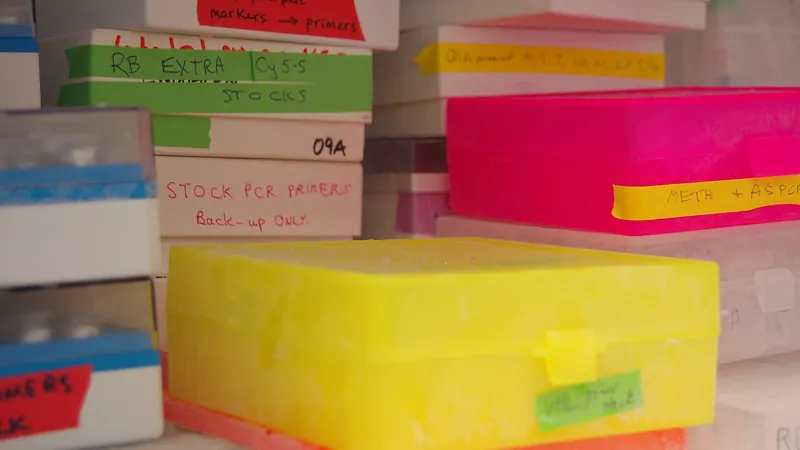
Written by Bali Peptide Supply from the sources listed above, each read in its own document on 16 Oct 2026. Every number about our lots comes from the Janoshik Analytical reports in the COA library, read by the site build, not typed by hand. The lead photo is from Wikimedia Commons under a free licence.
BP sells research materials for laboratory use only. This article explains laboratory testing and lab reports. It is not medical advice and not instructions for use.
Keep reading
 Reading reports
Measured content versus the label: why the numbers differ
The label is the amount the vial is meant to hold. The report is the amount the lab found. They are rarely identical.
2 min read · 4 sources Buying
Eight checks before you trust a peptide supplier
Labels and prices are easy to copy. These eight checks are not.
2 min read · 4 sources Reading reports
How to read a Janoshik test report, field by field
A lab report answers a few precise questions. This guide takes one real report from our COA library and reads it one field at a time.
4 min read · 3 sources